The Cellular Science: How Non-Thermal Photons Downregulate Facial Inflammation
At MICEYLIVE, we help you understand face and body light-care formats before choosing a device.
For individuals navigating the persistent erythema, sudden flushing, and barrier hypersensitivity of rosacea, introducing any new modality to the face can be an anxiety-inducing prospect. Light-emitting diode (LED) phototherapy has emerged as a clinically documented, non-invasive intervention designed to calm cutaneous reactivity through the biophysical mechanism of photobiomodulation (PBM). Unlike ablative laser resurfacing, intense pulsed light (IPL) platforms, or electrodessication procedures that rely on controlled photothermal tissue destruction, photobiomodulation is strictly non-thermal and non-ablative. When calibrated wavelengths of low-level visible red light (630–660 nm) and near-infrared light (830–850 nm) penetrate facial tissue, they deliver low-energy photons that stimulate natural enzymatic reactions without producing coagulative thermal injury.
At the cellular level, these photons are selectively absorbed by mitochondrial chromophores within dermal fibroblasts, endothelial cells, and resident macrophages. The primary intracellular photoacceptor is cytochrome c oxidase (Unit IV of the mitochondrial electron transport chain). Photonic absorption by cytochrome c oxidase accelerates respiratory electron transfer, increases mitochondrial membrane potential, and triggers an immediate upregulation of intracellular adenosine triphosphate (ATP) synthesis. Crucially for inflammatory dermatoses, this metabolic surge modulates transcription factors that govern immune reactivity, driving a marked downregulation of key pro-inflammatory cytokines, specifically interleukin-6 (IL-6), interleukin-8 (IL-8), and tumor necrosis factor-alpha (TNF-alpha). By downregulating these upstream biochemical drivers of vascular dilation and inflammation, photobiomodulation calms baseline tissue stress and fosters an environment conducive to dermal repair.
Key Takeaways: Rosacea-Safe LED Light Therapy at a Glance
-
Non-Thermal Mechanism: Red (630–660 nm) and near-infrared (830–850 nm) photons stimulate mitochondrial cytochrome c oxidase and downregulate inflammatory cytokines (IL-6, IL-8, TNF-alpha) without thermal damage.
-
The Thermal Trigger Threshold: Contact temperatures exceeding 38°C activate TRPV4 and TRPA1 ion channels on cutaneous sensory nerves, provoking immediate neurovascular vasodilation and rebound flushing.
-
Clinical Redness Reduction: Controlled clinical trials demonstrate that non-thermal LED phototherapy significantly reduces diffuse background erythema index scores and accelerates healing of inflammatory papules in rosacea.
-
Boundary on Broken Capillaries: LED therapy cannot eliminate permanently dilated structural telangiectasias (spider veins); destroying abnormal vessel lumens requires selective photothermolysis with vascular lasers (PDL 595 nm or KTP 532 nm).
-
Safe Dosing Parameters: Adhere strictly to gentle irradiance between 25 and 40 mW/cm² and start with 3 to 5 minute sessions to respect the Arndt-Schulz biphasic dose curve and prevent cellular exhaustion.
-
Clean Skin Requirement: Treatment must always be performed on clean, dry, bare skin; active exfoliating acids, retinoids, and essential oils should never be applied immediately prior to a light session.
The Thermal Paradox: Why Heat Triggers Flushing While Non-Thermal Light Soothes
Many rosacea sufferers encounter a confusing clinical paradox: while clinical literature praises red light for soothing redness, some users report experiencing acute, intense flushing flare-ups after wearing consumer LED masks at home. This divergence is rooted in the neurovascular pathophysiology of rosacea and the biological impact of heat. In rosacea-prone skin, cutaneous sensory nerve endings and epidermal keratinocytes display a marked overexpression of polymodal thermal receptors known as Transient Receptor Potential (TRP) channels, specifically TRPV4 and TRPA1. When facial skin surface temperature rises above 38°C (100.4°F), these temperature-sensitive channels activate instantly. Their activation triggers the immediate, antidromic release of potent vasoactive neuropeptides—such as Calcitonin Gene-Related Peptide (CGRP) and Substance P—which bind to precapillary sphincters, inducing rapid smooth-muscle relaxation and provoking intense, uncontrollable facial flushing.
The physical culprit behind these flare-ups is not the optical photon itself, but conductive heat accumulation from substandard hardware engineering. High-density light-emitting diodes convert a portion of electrical energy into thermal energy during operation. In rigid plastic "hockey-mask" style devices, tight encasements and poor heat dissipation trap convective heat directly against facial skin. Over a 10 to 15 minute session, contact surface temperatures inside poorly engineered rigid plastic masks can rapidly climb to 38°C, 40°C, or higher, directly breaching the TRPV4 thermal activation threshold and converting a therapeutic session into a severe neurovascular trigger. In contrast, medically designed flexible silicone masks engineered with cool-operating diode architecture dissipate semiconductor heat efficiently, maintaining operating contact temperatures strictly below 36°C (96.8°F) to ensure that the skin receives only pure, non-thermal photobiomodulation.
Subtype 1 vs. Subtype 2: What LED Light Can and Cannot Do for Rosacea
Navigating treatment expectations requires a nuanced understanding of rosacea subtypes and their differing anatomical manifestations. In Erythematotelangiectatic Rosacea (Subtype 1, ETR), patients present with transient flushing episodes that progress over time into persistent macular background erythema across the central face. In Papulopustular Rosacea (Subtype 2, PPR), this background erythema is accompanied by crops of inflammatory papules and sterile pustules that resemble acne vulgaris. Controlled clinical investigations, such as those conducted by Sorbellini et al. (2018), confirm that non-thermal red and near-infrared LED phototherapy delivers quantifiable benefits for both subtypes by soothing inflammatory pathways and speeding up the natural resolution of inflammatory papulopustular lesions. Objective spectrophotometric evaluations demonstrate statistically significant reductions in clinical erythema severity index scores, helping to quiet the chronic low-grade inflammatory state characteristic of reactive skin.
However, an absolute clinical boundary exists that every consumer must understand: LED face masks cannot eliminate or dissolve structural telangiectasias (spider veins). Telangiectasias are permanently dilated, ectatic microvessels located in the superficial papillary dermis whose muscular vessel walls have lost elasticity and become structurally fixed. Because photobiomodulation operates via non-thermal cellular stimulation rather than heat, it does not possess the physical mechanism required to photocoagulate or destroy vessel walls. Permanently erasing visible broken blood vessels requires selective photothermolysis, a medical laser procedure performed by dermatologists using pulsed dye lasers (PDL, 595 nm) or potassium titanyl phosphate lasers (KTP, 532 nm). These vascular lasers emit high-energy pulses that are selectively absorbed by intravascular oxyhemoglobin, generating localized heat that safely coagulates the vessel lumen so the body can resorb it. While an LED mask provides outstanding adjunctive care to reduce general background redness, it should never be purchased under the false expectation that it will erase distinct spider veins.
Wavelength Rules: Why Red and NIR Work While Blue Light Is Contraindicated
The efficacy of light therapy is strictly wavelength-dependent, governed by the optical penetration depths and absorption spectra of target facial tissues. Calibrated visible red light (633 nm) targets the superficial papillary dermis, where it suppresses pro-inflammatory cytokines and promotes microvascular endothelial stabilization. Near-infrared (NIR) light at 830 nm exhibits the lowest absorption coefficient for epidermal melanin and water, allowing photons to penetrate deeply—between 5 and 10 millimeters into the deep reticular dermis, subcutaneous tissue, and vascular networks. In this deeper zone, 830 nm photons stimulate perivascular macrophages, accelerating their phenotypic switch from the inflammatory M1 state to the reparative M2 state. Furthermore, near-infrared irradiation enhances local lymphatic endothelial flow, which actively drains pooled inflammatory exudates and extravasated erythrocytes, significantly reducing facial puffiness and chronic swelling associated with neurovascular flares.
Conversely, blue light (typically centered around 415 nm) is strictly contraindicated for individuals with rosacea and compromised barrier function. While blue light is widely celebrated in dermatology for its ability to destroy Cutibacterium acnes bacteria by exciting endogenous porphyrins, that exact photochemical reaction generates substantial intracellular singlet oxygen and free radicals. On resilient, acne-prone oily skin, this localized oxidative burst is tolerated; however, on hyper-reactive, barrier-compromised rosacea skin, blue light induces acute phototoxic stress. The shallow penetration depth of 415 nm light concentrates energy within the fragile epidermis, frequently provoking stinging, barrier deterioration, and severe rebound erythema. Rosacea patients should avoid multi-color "rainbow" masks and select devices emitting exclusively pure red (633 nm) and near-infrared (830 nm) wavelengths.
The 5-Point Rosacea-Safe Hardware Checklist: What to Look for Before Buying
Selecting an LED mask for reactive skin demands rigorous scrutiny of engineering specifications rather than influencer endorsements. Because rosacea skin reacts violently to heat, friction, and optical glare, consumers must evaluate hardware against five objective safety standards. First and foremost is contact thermal management: the device must maintain operating skin surface contact temperatures strictly below 36°C (96.8°F) throughout a complete treatment cycle, safely beneath the 38°C TRPV thermal activation threshold. Devices lacking thermal dissipation certifications under medical electrical standards (IEC 60601-1) pose an immediate hazard of heat-induced flushing.
Second, irradiance (power density) must fall within a gentle therapeutic window of 25 to 40 mW/cm². High-powered clinical panels boasting 80 to 100 mW/cm² deliver excessive photonic flux over short intervals, overwhelming delicate cutaneous cells and causing thermal accumulation that sensitive skin cannot tolerate. Third, the mask must feature a strict wavelength exclusivity policy: verified 633 nm red light and 830 nm near-infrared light with zero secondary blue light leakage.
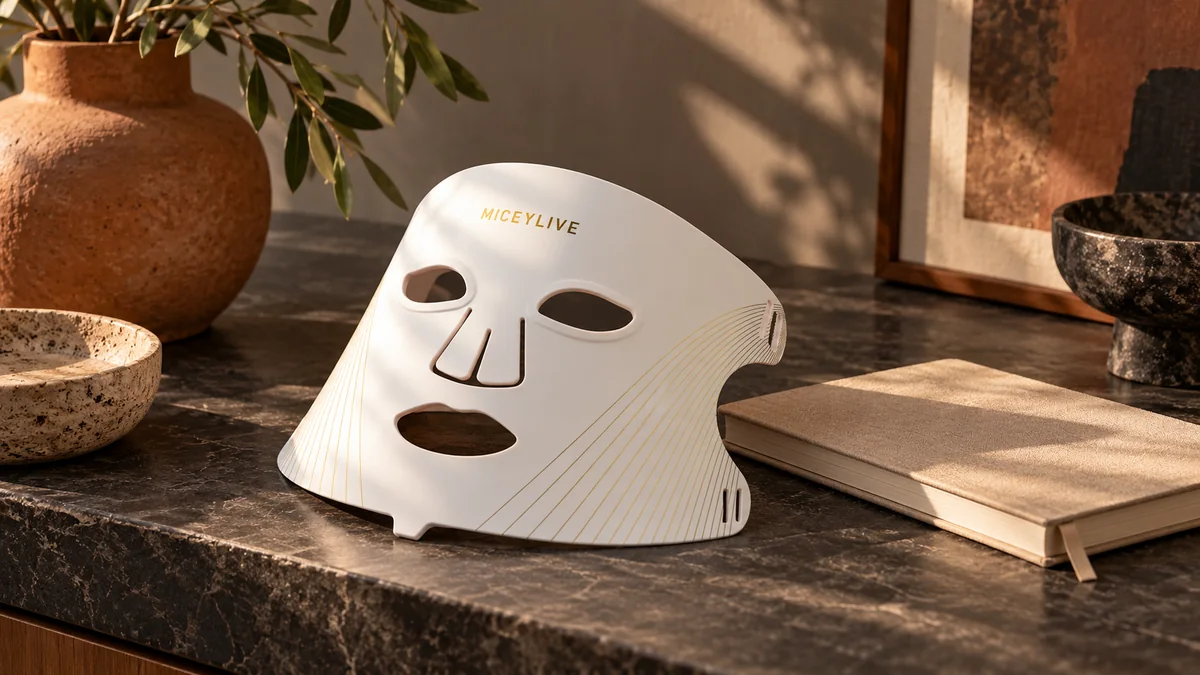
Fourth, mechanical ergonomics are paramount: the mask body should be constructed from flexible, medical-grade liquid silicone that naturally conforms to facial contours without rigid pressure points. Rigid hard-plastic shells frequently rub against sensitive malar cheeks and the nasal bridge, creating mechanical shear friction and pressure urticaria that trigger reactive redness. A flexible silicone design distributes weight evenly and maintains consistent diode-to-skin distance without friction.
Fifth, certified photobiological eye protection is non-negotiable. Up to 50% of rosacea sufferers experience ocular rosacea involvement, presenting with dry eyes, photophobia, blepharitis, and conjunctival injection. Facial devices emitting intense photon streams can cause severe glare discomfort and ocular fatigue. Compliant devices must pass IEC 62471 photobiological eye safety testing and incorporate built-in opaque silicone eye cups or certified blackout goggles that completely shield the peri-orbital ocular margin from direct optical glare.
The Rosacea-Safe Device Hardware Matrix: 5 Non-Negotiable Specifications
-
1. Operating Contact Temperature (<36°C): Must feature certified semiconductor thermal dissipation maintaining skin contact temperature strictly under 36°C, well below the 38°C TRPV4/TRPA1 flushing trigger threshold.
-
2. Gentle Irradiance Window (25–40 mW/cm²): Moderate power density delivers the optimal 4–10 J/cm² therapeutic dose over 10 minutes without thermal stress or cellular photo-inhibition.
-
3. Pure Wavelength Exclusivity (633 nm + 830 nm): Dual-wavelength architecture targeting superficial papillary and deep reticular layers; zero blue (415 nm) light or uncalibrated colored LEDs.
-
4. Flexible Medical-Grade Silicone Body: Soft, biocompatible silicone conforms to anatomical curves without mechanical friction, pressure points, or weight-bearing shear stress on reactive skin.
-
5. IEC 62471 Eye Safety & Built-in Shields: Compliant ocular radiation safety with opaque protective silicone eye cups to safeguard against photophobia and protect ocular rosacea barriers.
The 4-Week Gentle Acclimation Protocol: How to Introduce LED Therapy Safely
Introducing light therapy to hyper-reactive skin requires a disciplined, conservative ramp-up schedule. In biological phototherapy, cellular response adheres to the Arndt-Schulz biphasic dose law: low doses stimulate positive cellular responses, optimal doses maximize healing, while excessive doses induce cellular exhaustion or secondary inflammatory flare-ups. An optimal cumulative fluence between 4 and 10 J/cm² per session achieves maximum anti-inflammatory signaling. Jumping immediately into daily 15-minute sessions can easily push reactive skin past its bio-inhibitory threshold, precipitating acute rebound erythema.
Before ever strapping an LED mask onto the face, users must perform a 24-hour patch test. Place the illuminated mask over the inner forearm for 5 minutes, then observe the skin for 24 hours to confirm the absence of contact dermatitis, unexpected photosensitivity, or thermal urticaria. Once cleared, treatment begins on clean, completely bare, dry skin. Never apply active chemical exfoliants (AHA, BHA, gluconolactone), L-ascorbic acid, retinoids, benzoyl peroxide, or essential oils immediately prior to light exposure. Active ingredients alter the skin's optical properties, increase photosensitivity, and trap heat, creating severe phototoxic irritation. Following the session, users should immediately apply a gentle, barrier-repair moisturizer containing physiological ceramides, centella asiatica, or squalane to lock in hydration and soothe the cutaneous mantle.
The 4-Week Gentle Rosacea Acclimation Checklist
-
Step 0: 24-Hour Forearm Patch Test: Illuminate inner forearm for 5 minutes; wait 24 hours to rule out idiosyncratic photosensitivity before facial exposure.
-
Week 1: Introduction Phase: 3 to 5 minutes per session, exactly 2 times weekly on non-consecutive days (e.g., Tuesday and Friday); evaluate skin recovery for 48 hours following each session.
-
Week 2: Conditioning Phase: 5 to 7 minutes per session, 3 times weekly (e.g., Monday, Wednesday, Friday); observe facial baseline erythema.
-
Week 3: Consolidation Phase: 8 to 10 minutes per session, 3 times weekly; assess skin tolerance and microvascular resilience.
-
Week 4 & Beyond: Maintenance Phase: Standard 10 minutes per session, 3 to 4 times weekly; continue consistent routine to sustain cytokine downregulation.
-
Session Preparation Rule: Perform only on bare, thoroughly dried skin cleansed with a gentle, non-foaming cream cleanser; apply prescribed barrier-repair moisturizers immediately AFTER the session.
Integrating LED Therapy with Prescription Treatments & Common FAQs
A vital message for every rosacea patient is that at-home LED face masks are supportive, non-invasive adjunctive devices—they are not a standalone cure for chronic rosacea, nor should they ever replace medical care directed by a board-certified dermatologist. Rosacea is a complex, progressive neurovascular and immune condition driven by underlying genetic predispositions, Demodex mite proliferation, and neurovascular instability. First-line clinical management frequently requires prescription topical therapies (such as 15% azelaic acid gel, 1% ivermectin cream, or 0.75% metronidazole gel) or oral systemic interventions (such as low-dose anti-inflammatory doxycycline). LED phototherapy serves as an exceptional complementary partner that reduces baseline inflammation and enhances barrier tolerance to prescription topicals, but patients must never discontinue their dermatological medications. The clinical rule of thumb for product layering is simple: complete the LED phototherapy session on bare skin first, allow the skin to cool for 5 minutes, and then apply prescription medications followed by a calming barrier moisturizer.
Frequently Asked Questions: Rosacea Safety, Expectations & Devices
-
Q: Can an LED face mask permanently cure my rosacea? A: No. Rosacea is a chronic genetic and neurovascular condition with no permanent cure. LED face masks provide adjunctive supportive care that soothes diffuse background redness and strengthens barrier function, but they must be used consistently alongside medical management.
-
Q: Will red light therapy get rid of my broken capillaries and spider veins? A: No. Non-thermal photobiomodulation cannot photocoagulate structural telangiectasias. Destroying broken capillaries requires selective photothermolysis with in-office vascular lasers, such as Pulsed Dye Laser (PDL 595 nm) or KTP (532 nm).
-
Q: Is blue light safe to use if I have acne and rosacea at the same time? A: Blue light (415 nm) is contraindicated for rosacea-prone skin because it generates localized reactive oxygen species that provoke barrier irritation and rebound erythema. Stick exclusively to red (633 nm) and near-infrared (830 nm) light.
-
Q: Are LED masks safe if I suffer from ocular rosacea? A: Yes, provided the device complies with IEC 62471 photobiological eye safety standards and includes opaque protective silicone eye shields. Because 50% of rosacea sufferers have ocular involvement, direct intense optical glare must be blocked during sessions.
-
Q: How long does it take to see visible redness reduction? A: Clinical trials show initial improvements in skin comfort and barrier hydration within 3 to 4 weeks, with measurable reductions in erythema index scores and papule counts achieved after 8 to 12 weeks of consistent use (3 to 4 sessions weekly).
Compare the documented controls and formats in our MICEYLIVE face light therapy collection.
For the next step, read our guide to Do LED Face Masks Really Work? A Dermatological & Biophysical Guide.