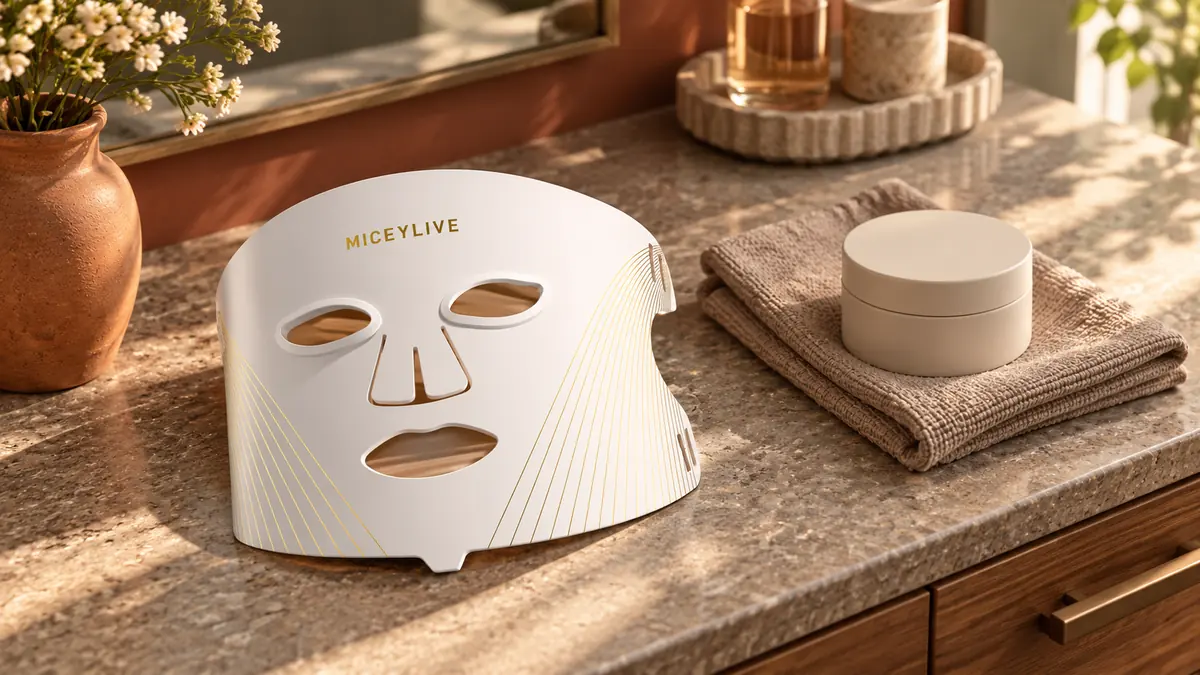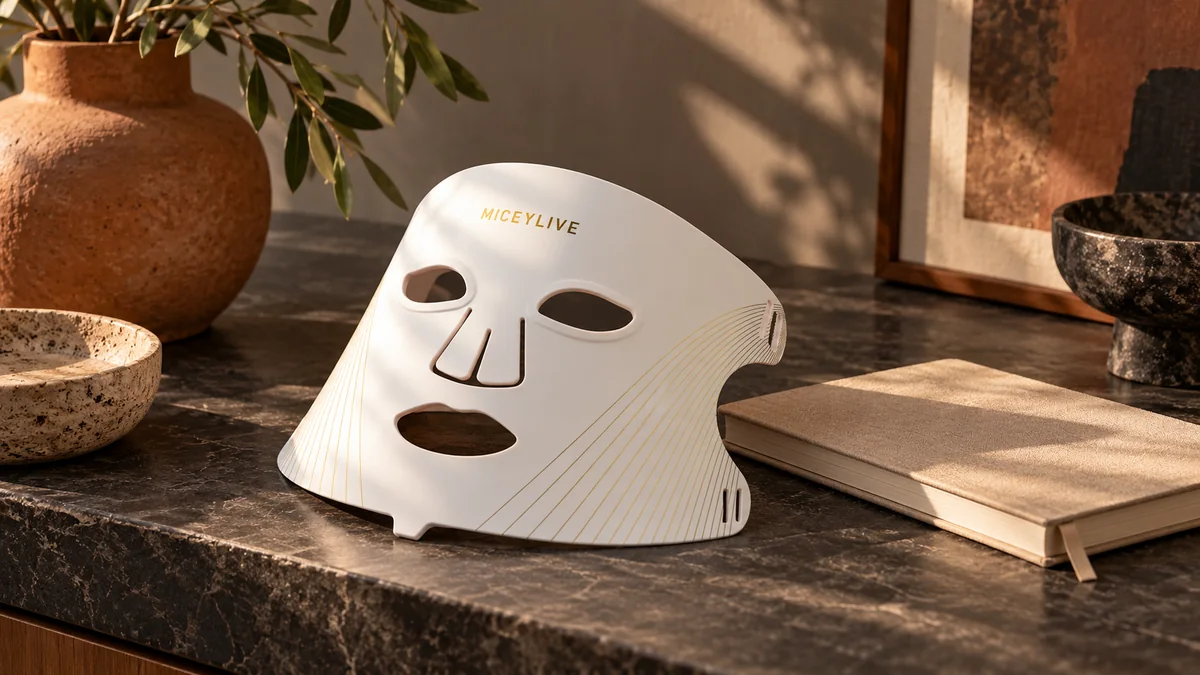
Light-emitting diode (LED) face masks have transitioned from specialized dermatological clinics into home skincare routines, raising an essential question: do these wearable optical devices actually deliver measurable skin rejuvenation, or are they merely expensive consumer novelties? Photobiomodulation (PBM) is a legitimate, well-documented biological process where specific light wavelengths interact directly with human cells without causing thermal damage.
At MICEYLIVE, we help you understand face and body light-care formats before choosing a device.
However, consumers must understand that at-home LED face masks operate at lower optical power densities than medical-grade clinical lasers and panels, producing subtle, gradual cosmetic enhancements that depend entirely on sustained consistency over weeks and months rather than immediate overnight transformations.
-
Biological Mechanism: LED phototherapy works through photobiomodulation; light photons are absorbed by mitochondrial photoreceptors inside dermal cells to stimulate cellular energy rather than heating or ablating tissue.
-
Clinical Collagen Remodeling: Peer-reviewed clinical trials demonstrate that combining 633nm red light and 830nm near-infrared light significantly increases intradermal collagen density and reduces fine wrinkle depth.
-
Realistic Timelines: Visible skin radiance and texture smoothing require diligent adherence over a 4 to 12-week timeframe, typically requiring three to five sessions per week.
-
At-Home Expectations: Consumer LED face masks provide gentle, cumulative maintenance improvements and do not match the rapid, intensive results of ablative in-office clinical laser procedures.
-
Hardware Proximity Matters: Optical irradiance diminishes rapidly with distance; flexible medical-grade silicone masks that rest flush against facial contours deliver far more uniform and potent energy than loose, rigid plastic shells.
How LED Light Therapy Works at the Cellular Level
To evaluate whether LED face masks work, one must first distinguish photobiomodulation from conventional cosmetic light treatments such as intense pulsed light (IPL) or ablative laser resurfacing. While traditional dermatological lasers rely on photothermolysis—intentionally generating controlled thermal micro-injuries to force a wound-healing response—LED phototherapy is completely non-thermal and non-destructive. Inside living human cells, light photons within specific red and near-infrared spectral bands penetrate epidermal layers to reach dermal fibroblasts, where they are directly absorbed by specialized photoacceptors within the mitochondrial respiratory chain. This light absorption reverses nitric oxide inhibition, elevates mitochondrial membrane potential, and drives cellular adenosine triphosphate (ATP) synthesis, effectively energizing cells to carry out essential repair pathways. Simultaneously, photobiomodulation induces a transient, low-level release of reactive oxygen species (ROS) that functions as a physiological signaling cascade, activating pro-survival transcription factors such as NF-kB and AP-1 without inducing oxidative cellular damage.
Mitochondrial Absorption: Cytochrome c Oxidase and ATP Generation
The primary biological engine behind red and near-infrared phototherapy is cytochrome c oxidase (CCO), a pivotal copper-containing enzyme situated within Complex IV of the mitochondrial respiratory chain. Under conditions of cellular oxidative stress or chronological aging, nitric oxide (NO) binds competitively to cytochrome c oxidase, displacing oxygen and impeding the efficient synthesis of cellular fuel. When targeted red photons (around 633nm) or near-infrared photons (around 830nm) penetrate the tissue, they are absorbed by the catalytic metal centers of CCO, inducing the photo-dissociation of inhibitory nitric oxide. Once relieved of nitric oxide blockade, oxygen binding is restored, electron transport accelerates, and mitochondrial respiration dramatically ramps up the production of adenosine triphosphate (ATP). This surge in cellular bio-energy enables dermal fibroblasts to efficiently synthesize extracellular matrix components, support enzymatic repair mechanisms, and accelerate tissue recovery.
Clinical Proof: What 633nm Red and 830nm Near-Infrared Actually Do
The therapeutic validity of phototherapy rests on randomized controlled clinical trials evaluating specific wavelength bands. In dermatological photomedicine, the combination of 633nm visible red light and 830nm invisible near-infrared light represents the gold standard for non-invasive skin rejuvenation. A landmark controlled trial involving 110 subjects demonstrated that regular exposure to red and near-infrared light resulted in statistically significant increases in intradermal collagen density, objectively quantified using high-frequency ultrasonographic measurements, alongside profilometric reductions in skin roughness and fine wrinkles. Double-blind clinical trials further corroborate that subjects receiving combined red and near-infrared phototherapy show marked profilometric improvements in periorbital and perioral wrinkle reduction compared to sham control groups.
At the microscopic and biochemical level, split-face double-blind trials have revealed that LED irradiation upregulates type I procollagen synthesis and increases the expression of tissue inhibitors of metalloproteinases (TIMP-1 and TIMP-2). By elevating TIMP levels, photobiomodulation actively suppresses matrix metalloproteinase-1 (MMP-1), the primary enzymatic driver of collagen breakdown, thereby preserving dermal architecture and promoting extracellular remodeling without disrupting the stratum corneum or causing peeling.
Realistic Expectations: At-Home Masks vs. In-Office Treatments
A primary cause of consumer dissatisfaction with LED face masks stems from distorted expectations created by hyperbolic advertising. Clinical trials evaluating photobiomodulation follow rigorous multi-week treatment courses; subjects in benchmark studies underwent 30 standardized treatment sessions across several months to achieve visible profilometric smoothing. Measurable improvements in skin texture, elasticity, and fine lines require cumulative treatment adherence over an 8 to 12-week period, with early subtle improvements in skin radiance typically becoming noticeable around weeks 3 to 4.
Furthermore, board-certified dermatologists emphasize that at-home consumer masks deliver substantially lower optical power densities than professional in-office light panels, meaning they produce modest, gradual aesthetic enhancements rather than the dramatic, rapid tightening seen with clinical fractional lasers or deep chemical peels. At-home masks should be approached as long-term preventative and maintenance devices that support collagen preservation through habitual weekly use (typically 3 to 5 sessions of 10 to 15 minutes each) rather than instant fixes.
Hardware Physics: Irradiance, Dose, and Why Mask Fit Matters
Not all LED masks on the market are engineered equally; biological efficacy is governed strictly by optical physics and dosimetry. Photobiomodulation obeys the Arndt-Schulz biphasic dose-response curve, an established biophysical principle stating that low-level stimulation elicits biological activity, optimal energy doses achieve maximum cellular benefits, and excessive exposure induces bio-inhibition or photo-suppression. For skin phototherapy, the therapeutic window requires an irradiance (power density) of approximately 30 to 50 mW/cm2 and an energy fluence of 2 to 10 J/cm2. If an underpowered device emits insufficient irradiance, prolonged session times cannot compensate to reach the activation threshold. Crucially, delivered irradiance is dictated by the Inverse-Square Law of optical physics, which dictates that light intensity decreases proportionally to the square of the distance from the diode (E = I / d^2). Because distance causes rapid photon dispersion, flexible medical-grade silicone masks that mold directly against the facial contours deliver substantially higher and more uniform photon densities to target dermal chromophores than rigid plastic shells that hover 1 to 3 centimeters away from the nose, cheeks, and periorbital regions.
Blue Light: Bacterial Acne Clearing vs. Melasma & Pigmentation Risks
Many multi-wavelength masks feature visible blue light, commonly calibrated around 415nm, as an anti-acne solution. Blue light functions through an entirely distinct photochemical mechanism compared to red photobiomodulation: Cutibacterium acnes (formerly P. acnes) bacteria naturally synthesize and store endogenous porphyrins, primarily coproporphyrin III. When exposed to 415nm short-wavelength blue light, these porphyrins absorb the photons and undergo photochemical excitation, generating cytotoxic reactive singlet oxygen that ruptures bacterial cell membranes and rapidly reduces active inflammatory papules and pustules.
However, this bactericidal benefit carries a critical dermatological caveat: clinical photobiology studies demonstrate that short-wavelength visible blue light stimulates OPN3 (opsin 3) photoreceptors expressed on human epidermal melanocytes. In individuals with darker skin tones—specifically Fitzpatrick skin types IV through VI—OPN3 activation induces sustained tyrosinase expression, triggering prolonged, intense hyperpigmentation and potentially exacerbating melasma or post-inflammatory hyperpigmentation (PIH). Consequently, while blue light is clinically valuable for fair-skinned individuals (Fitzpatrick I–III) battling inflammatory breakouts, patients prone to melasma or those with deeper skin tones should exercise extreme caution and instead rely on red and near-infrared light, which do not stimulate melanogenesis.
Safety, Contraindications, and What to Look for When Buying
While low-level light therapy is non-invasive and generally safe for daily use, medical contraindications must be strictly observed. At-home LED masks are contraindicated for individuals taking photosensitizing medications—such as oral isotretinoin, tetracycline-class antibiotics, or photosensitizing diuretics—which can cause severe erythema, blistering, or phototoxic skin reactions upon light exposure. Patients diagnosed with photosensitive autoimmune disorders, including systemic lupus erythematosus, should similarly avoid light-emitting devices. Ocular protection represents another essential safety consideration: staring directly into high-intensity LED diodes, particularly short-wavelength blue light, poses photochemical retinal hazards, making built-in opaque silicone eye inserts or certified protective goggles mandatory during sessions. Finally, consumers should confirm that an at-home mask has secured FDA 510(k) clearance or an equivalent CE medical mark, certifying that the electrical components, heat management, and optical emissions have undergone independent testing for consumer safety.
-
Verified Irradiance Window: Ensure the manufacturer provides verified optical power density within the 30 to 50 mW/cm2 therapeutic range, delivering an energy fluence between 2 and 10 J/cm2.
-
Flexible Silicone Construction: Prioritize flexible, medical-grade silicone designs that rest flush against facial contours over rigid plastic shells, ensuring minimal photon dispersion via the inverse-square law.
-
Medication Safety Review: Confirm that you are not currently taking oral isotretinoin, tetracyclines, or other photosensitizing medications before initiating treatment.
-
Built-in Eye Protection: Verify the presence of integrated opaque silicone eye cups to safeguard ocular tissues from direct diode emission.
-
Regulatory Clearance: Check for documented FDA 510(k) clearance or CE certification to ensure baseline consumer electrical, thermal, and optical safety.
For the next step, read our guide to How to Use an LED Face Mask: The Definitive Routine & Care Guide.